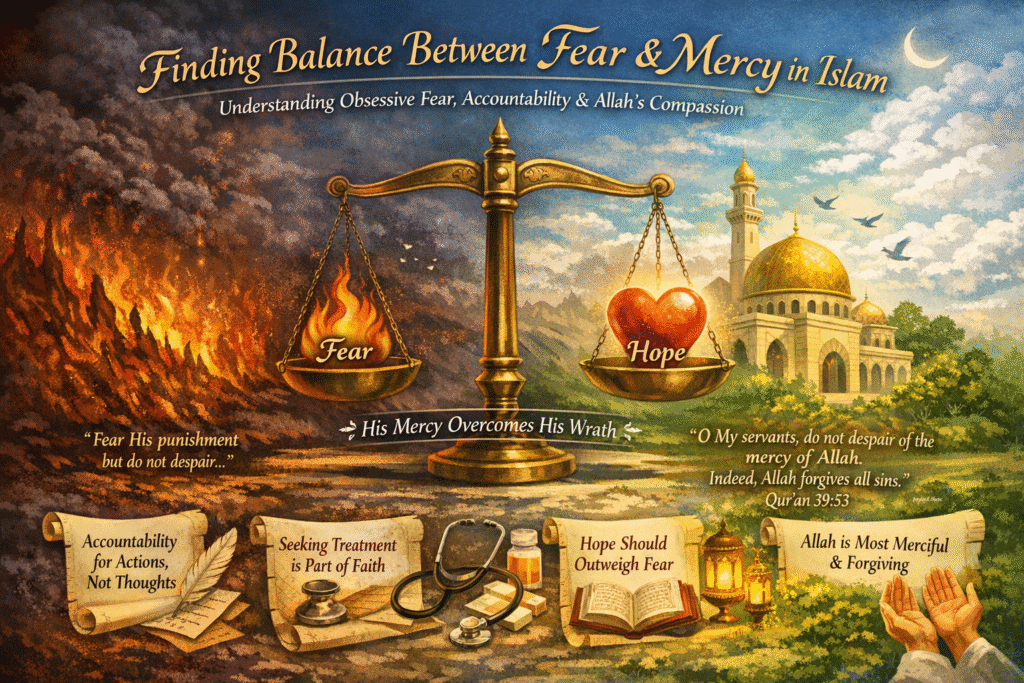
Understanding Obsessive Fear, Accountability, and Allah’s Compassion
Islam is a religion of balance. It does not ask believers to live in constant terror, nor does it promote heedlessness. Instead, Allah calls us to walk a middle path—between fear that protects the heart and hope that keeps it alive.
For many believers, especially those living with anxiety, OCD, trauma, or other mental health conditions, this balance can feel extremely difficult. Fear can grow overwhelming and turn into distress rather than guidance. Islam recognizes this difference.
Allah’s Mercy Comes First
Allah makes it very clear that His mercy is greater than His punishment:
“Say, ‘O My servants who have wronged themselves, do not despair of the mercy of Allah. Indeed, Allah forgives all sins. He is the Most Forgiving, the Most Merciful.’”
(Qur’an 39:53)
This verse was revealed to people who had committed serious sins. It is a direct invitation to return, not a threat meant to push people away.
The Prophet ﷺ said that Allah’s mercy overcomes His wrath, and that Allah says:
“I am as My servant thinks of Me.”
This means how we understand Allah matters. Seeing Him only as punishing while ignoring His mercy is not the full Islamic picture.
Fear in Islam: Healthy vs. Harmful
Islam does not deny fear. A healthy fear reminds a person to pray, to repent, and to stay mindful of Allah. This fear is calm, motivating, and grounded in hope.
But obsessive fear is different.
Obsessive fear:
- Causes constant guilt even after repentance
- Leads to despair rather than growth
- Interferes with daily life and worship
- Comes from anxiety, OCD, or trauma
- Makes a person feel they are never good enough
This type of fear is not what Islam asks of believers.
Allah does not burden a soul beyond what it can bear. He knows the difference between:
- deliberate choices
- intrusive thoughts
- mental health struggles
- trauma responses
A Just and Merciful God does not punish someone for what is beyond their control.
Accountability Is for Actions, Not Intrusive Thoughts
In Islam, accountability is tied to intentional actions, not uncontrollable thoughts or fears.
The Prophet ﷺ taught that Allah has pardoned the thoughts that cross a person’s mind as long as they are not acted upon.
This is especially important for people with moral scrupulosity OCD, where the heart is constantly alarmed, even when no sin has occurred. Feeling intense guilt does not mean someone is sinful—it often means their conscience is very sensitive.
Repentance Truly Wipes the Slate Clean
Sincere repentance (tawbah) means:
- acknowledging the mistake
- turning back to Allah
- intending not to repeat it
When this happens, the sin is erased. Completely.
Allah may even replace past sins with good deeds.
And for those who repent sincerely, Allah conceals their sins on the Day of Judgment. They are not exposed or humiliated. Forgiveness happens privately, between the servant and their Lord.
Islam Recognizes Mental Health
Seeking medical care, therapy, or medication is not a lack of faith.
The Prophet ﷺ sought medical treatment and encouraged others to do the same. His wife Aisha (may Allah be pleased with her) learned medicine by listening to healers who treated him.
Islamic history also shows that OCD was recognized (reference), described, and treated by Muslim scholars over a thousand years ago. This proves that mental health struggles are not new—and they were never dismissed as weak iman.
Prayer and Qur’an are powerful, but they are not meant to replace treatment when treatment is needed. Just as someone cannot “pray away” a broken bone, mental illness also requires care.
Fear of Hellfire: A Warning, Not a Threat
Allah mentions Hellfire not out of cruelty, but out of mercy—like a parent warning a child about fire to protect them.
For someone with trauma related to fire, these descriptions can feel especially overwhelming. Allah knows this. He knows personal history, pain, and fear. He does not judge people the same way humans do.
Islam constantly reminds us:
- Allah wants ease for you, not hardship
- Allah wants to give you Jannah
- Allah loves those who keep returning to Him
Hope Must Be Stronger Than Fear
Fear without hope leads to despair. Hope without responsibility leads to negligence. Islam calls us to hold both—but never let fear overpower hope.
Acts of kindness matter. Charity matters. Caring for animals matters. Even a single sincere act, done with compassion, can be a reason for Allah’s mercy—as shown in the well-known story of the woman forgiven for giving water to a dog.
Conclusion: Walking the Middle Path
A believer struggling with anxiety, OCD, autism, PTSD, depression, or any mental health condition is not failing Islam. Struggling does not mean lacking faith.
Allah sees effort. Allah sees intention. Allah sees pain.
The path to Allah is not about perfection—it is about returning, again and again, with hope.
And Allah is always closer than we think.
Obsessional Disorders in al-Balkhi’s 9th century treatise: Sustenance of the Body and Soul – PubMed
